

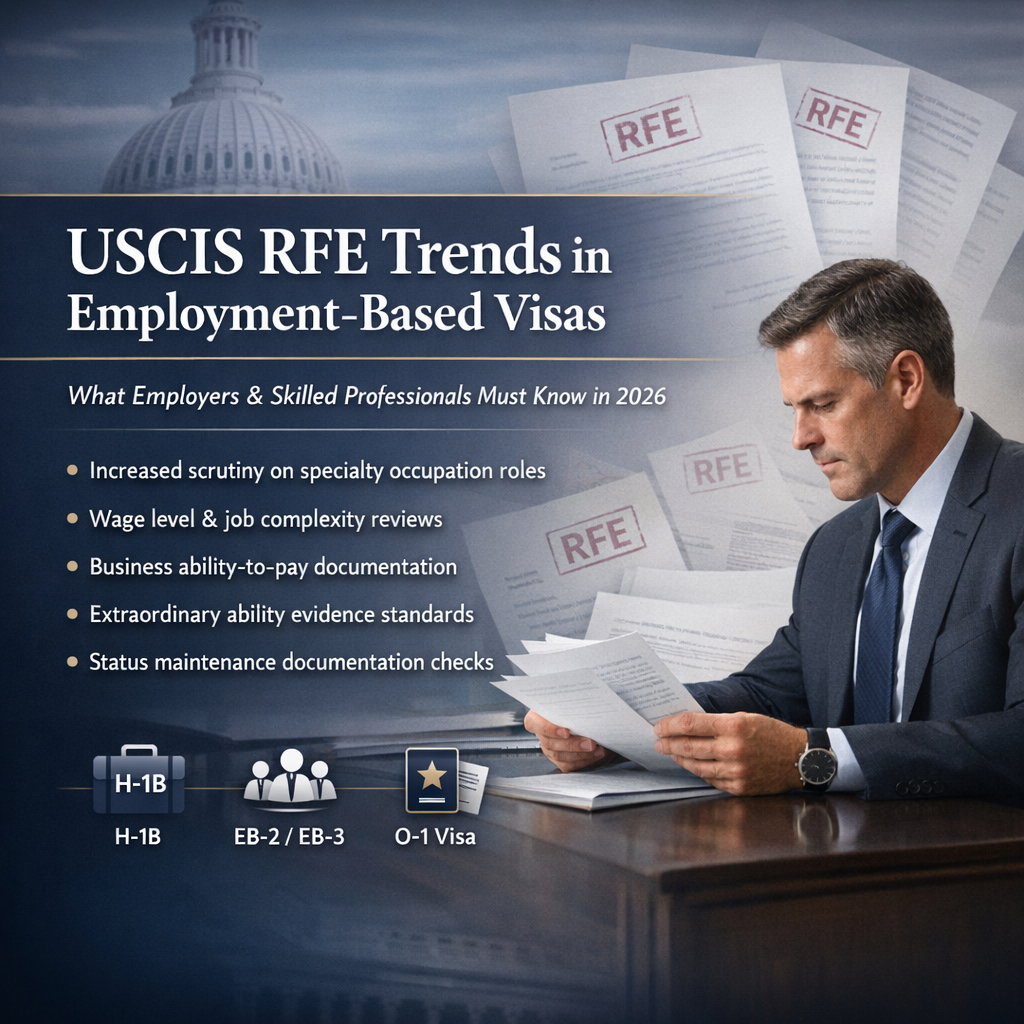
Employment-based immigration in the United States continues to evolve, and one critical indicator of adjudication patterns is the rise and shift in Requests for Evidence (RFEs) issued by U.S. Citizenship and Immigration Services (USCIS).
For employers, HR teams, and foreign professionals, understanding RFE trends is essential to minimize delays, avoid denials, and strengthen petition filings.
What Is an RFE?
A Request for Evidence (RFE) is issued by USCIS when an adjudicating officer determines that additional documentation is required to make a final decision on a petition. It does not mean denial — but it does indicate that the initial filing lacked sufficient supporting evidence.
RFEs are commonly seen in employment-based visa categories such as:
- H-1B (Specialty Occupation Workers)
- L-1 (Intra-Company Transferees)
- O-1 (Individuals with Extraordinary Ability)
- EB-1, EB-2, EB-3 Immigrant Petitions
Current RFE Trends in Employment-Based Visas
1. Increased Scrutiny on Specialty Occupation (H-1B)
Although approval rates have stabilized compared to prior years, USCIS continues to scrutinize:
- Employer-employee relationships
- Availability of specialty occupation work
- Third-party placement documentation
- Detailed job descriptions and degree alignment
Petitions lacking detailed job duties tied to specific academic requirements frequently receive RFEs.
2. Wage Level & Job Complexity Questions
USCIS officers are examining whether:
- The offered wage level corresponds with job complexity
- Entry-level wages match claimed advanced responsibilities
Discrepancies between wage level and job duties often trigger requests for clarification.
3. Business Legitimacy & Ability to Pay
For immigrant petitions (EB categories), RFEs frequently focus on:
- Employer’s financial ability to pay the proffered wage
- Tax returns and audited financial statements
- Ongoing business operations and revenue
Startups and small businesses face heightened documentation requirements.
4. Extraordinary Ability & National Interest Waiver Cases
In O-1 and EB-2 NIW filings, USCIS is increasingly requesting:
- Independent expert opinion letters
- Evidence of sustained national/international acclaim
- Proof of impact beyond normal job performance
Petitions must clearly demonstrate distinction beyond peers.
5. Maintenance of Status & Documentation Gaps
Technical errors such as:
- Missing prior approval notices
- Incomplete travel history
- Gaps in employment
- Unsigned forms
continue to result in avoidable RFEs.
Why Are RFEs Increasing?
Several factors contribute to evolving RFE patterns:
- Policy interpretation shifts
- Fraud prevention measures
- Adjudication consistency efforts
- Increased petition volumes
While overall RFE rates fluctuate annually, documentation standards remain high.
How to Minimize RFE Risk
Proactive petition strategy significantly reduces RFE probability. Best practices include:
✔ Detailed, role-specific job descriptions
✔ Strong evidentiary documentation
✔ Clear wage justification
✔ Consistent organizational charts
✔ Independent expert evaluations (when applicable)
✔ Legal review prior to submission
Early legal strategy is more cost-effective than responding to an RFE.
Final Thoughts
USCIS adjudication trends emphasize one key principle: precision matters. Employment-based petitions must be thoroughly documented, strategically structured, and legally compliant.
If you are an employer sponsoring foreign talent or a professional navigating the U.S. immigration system, proper preparation is critical.
Need Guidance?
Mantra Law Office provides strategic immigration counsel for employment-based petitions, RFE responses, and compliance planning.
📞 Contact us today to schedule a consultation and strengthen your petition strategy.