

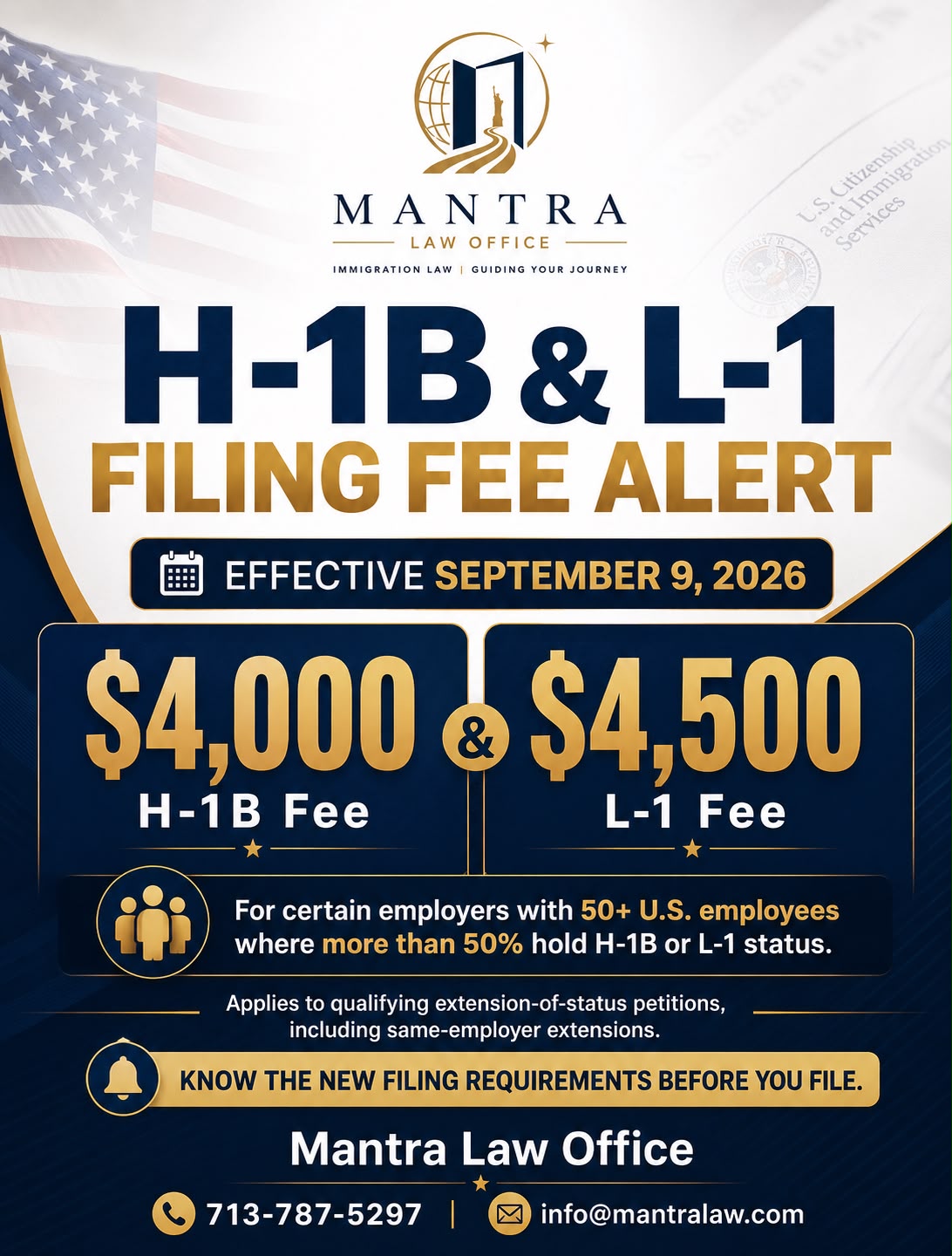
H-1B & L-1 Filing Fee Alert: New $4,000 and $4,500 Fees for Certain Extension Petitions Starting September 9, 2026
A significant change is coming for certain employers filing H-1B and L-1 petitions.
Beginning September 9, 2026, a new DHS rule will expand when the existing 9-11 Response and Biometric Entry-Exit Fee applies to certain H-1B and L-1 petitions.
For covered employers, the additional fee will apply not only to qualifying initial petitions and changes of employer, but also to extension-of-status petitions—even when the employee is continuing with the same employer.
What Are the New Fees?
For qualifying petitions:
- H-1B: $4,000 additional fee
- L-1: $4,500 additional fee
These are not new visa categories or new application types. Rather, the rule changes how the existing 9-11 Biometric Fee is applied to certain petitions. DHS says the fee is intended to support federally mandated biometric entry-exit programs.
Who Is Affected?
The rule applies to covered employers—generally, employers that:
- Have 50 or more employees in the United States, and
- Have more than 50% of their U.S. workforce in H-1B or L-1 status.
This means the new requirement does not automatically apply to every H-1B or L-1 petition filed in the United States.
The employer’s workforce composition is an important part of determining whether the additional fee applies.
The Important Change: Same-Employer Extensions
This is where the new rule could have a significant practical impact.
Previously, the 9-11 Biometric Fee generally applied to qualifying petitions involving an initial grant of status or a change of employer. Same-employer extension petitions were not subject to the fee under DHS’s prior interpretation.
Under the new rule, qualifying covered employers must also pay the fee for extension-of-status petitions where the employee remains with the same employer.
In simple terms:
Before September 9:
Same-employer extension → generally no 9-11 Biometric Fee
Starting September 9:
Qualifying covered employer + H-1B/L-1 extension → additional $4,000 / $4,500 fee
Why Employers Should Pay Attention
For companies that regularly sponsor H-1B and L-1 employees, the change could have a meaningful impact on immigration-related costs.
Employers should review upcoming filings and determine:
- Whether they meet the definition of a covered employer.
- Whether the petition is subject to the expanded fee requirement.
- Whether an upcoming extension should include the additional fee.
- Whether filing timelines and budgets need to be adjusted.
The Federal Register notes that the rule is intended to apply the fee to all H-1B and L-1 petitions filed by covered employers seeking an initial grant or extension of status, regardless of whether the extension involves a change of employer.
What Employers Should Do Now
September 9, 2026 is the effective date.
Employers with substantial H-1B and L-1 populations should not assume that a routine same-employer extension will remain subject to the same fee structure.
Review your workforce composition, identify upcoming H-1B and L-1 extensions, and determine whether the new fee applies before filing.
Bottom Line
The key takeaway is simple:
For certain employers, H-1B and L-1 extension petitions are about to become more expensive.
The new rule expands the $4,000 H-1B and $4,500 L-1 9-11 Biometric Fee to qualifying same-employer extensions beginning September 9, 2026.
If your company sponsors H-1B or L-1 employees, understanding whether this rule applies to your upcoming petitions can help you avoid unexpected filing costs or delays.
For guidance regarding your specific immigration matter, contact Mantra Law Office.
Mantra Law Office
U.S. Immigration Law
713-787-5297
info@mantralaw.com
This article is for informational purposes only and does not constitute legal advice. Immigration laws and policies are subject to change. Consult qualified immigration counsel regarding your specific circumstances.